
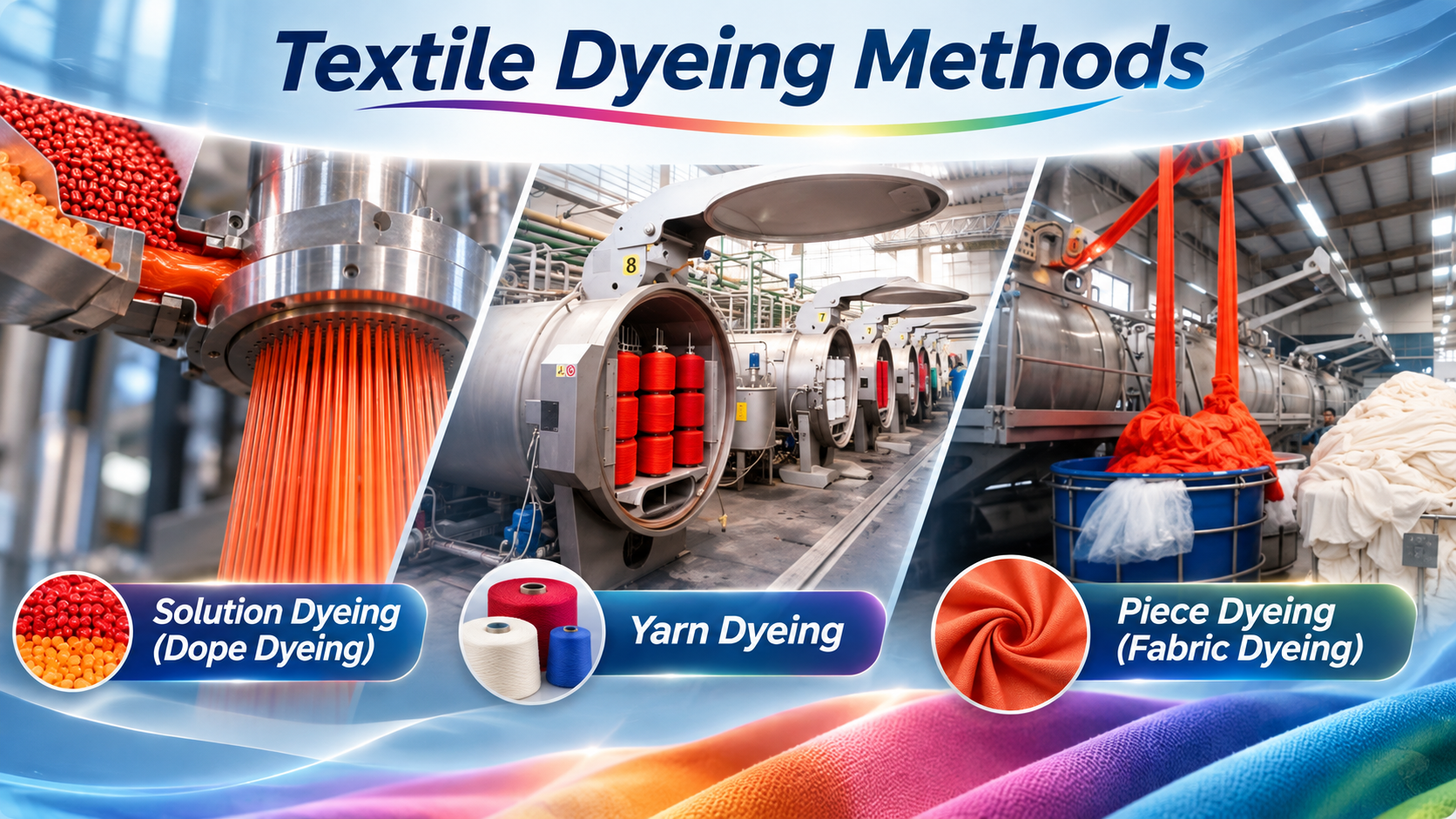
Textile dyeing processes introduce color at different stages of production, from fiber formation to yarn and finished fabric. This guide compares dope dyeing, yarn dyeing and piece dyeing to help apparel brands and sourcing teams understand their roles in fabric development.
Textile Dyeing Methods
Solution Dyeing (Dope Dyeing)
Yarn Dyeing
Piece Dyeing (Fabric Dyeing)

Solution Dyeing (Dope Dyeing)
Color starts at the fiber stage—not in the dye bath.
In solution dyeing, also called dope dyeing, color masterbatch is blended with polymer chips before melt spinning. The colored melt passes through spinnerets to form pre-colored filaments, which are then drawn and wound into yarn. By integrating coloration into fiber production, manufacturers can reduce the need for conventional wet-dyeing steps and deliver consistent shades and durable color performance.
From pigment selection to finished yarn, the process follows four key stages:
- Prepare the Color Masterbatch
• Color matching: Pigments are compounded with a carrier resin to achieve the target shade.
• Polymer selection: Polyester or nylon chips provide the base material for spinning.
• Accurate dosing: Masterbatch and polymer are weighed and mixed for consistent coloration. - Melt and Homogenize
• Melting: The blended chips enter an extruder and become a viscous polymer melt. The source notes a typical range of 260–300°C.
• Mixing: Pigments are dispersed evenly throughout the melt for uniform color. - Filter and Extrude Filaments
• Filtration: Fine filters remove particles that could obstruct the spinneret.
• Spinning: Metering pumps push the colored melt through spinneret holes to form continuous filaments. - Cool, Draw and Wind
• Quenching: Cool air solidifies the newly extruded filaments.
• Drawing: Heated rollers orient polymer chains and improve fiber performance.
• Winding: The colored filaments are collected as solution-dyed yarn.
Dope Dyeing Process Video
Watch the video for a closer look at the process.
Source: Original video on YouTube
Third-party video shared for educational reference. Not produced by HITEK TEXTILE.
Yarn Dyeing: Color Before Fabric
Yarn dyeing adds color before yarns are knitted or woven. This method is especially useful for yarn-dyed stripes, checks and jacquard designs, creating rich visual depth and distinctive fabric patterns.
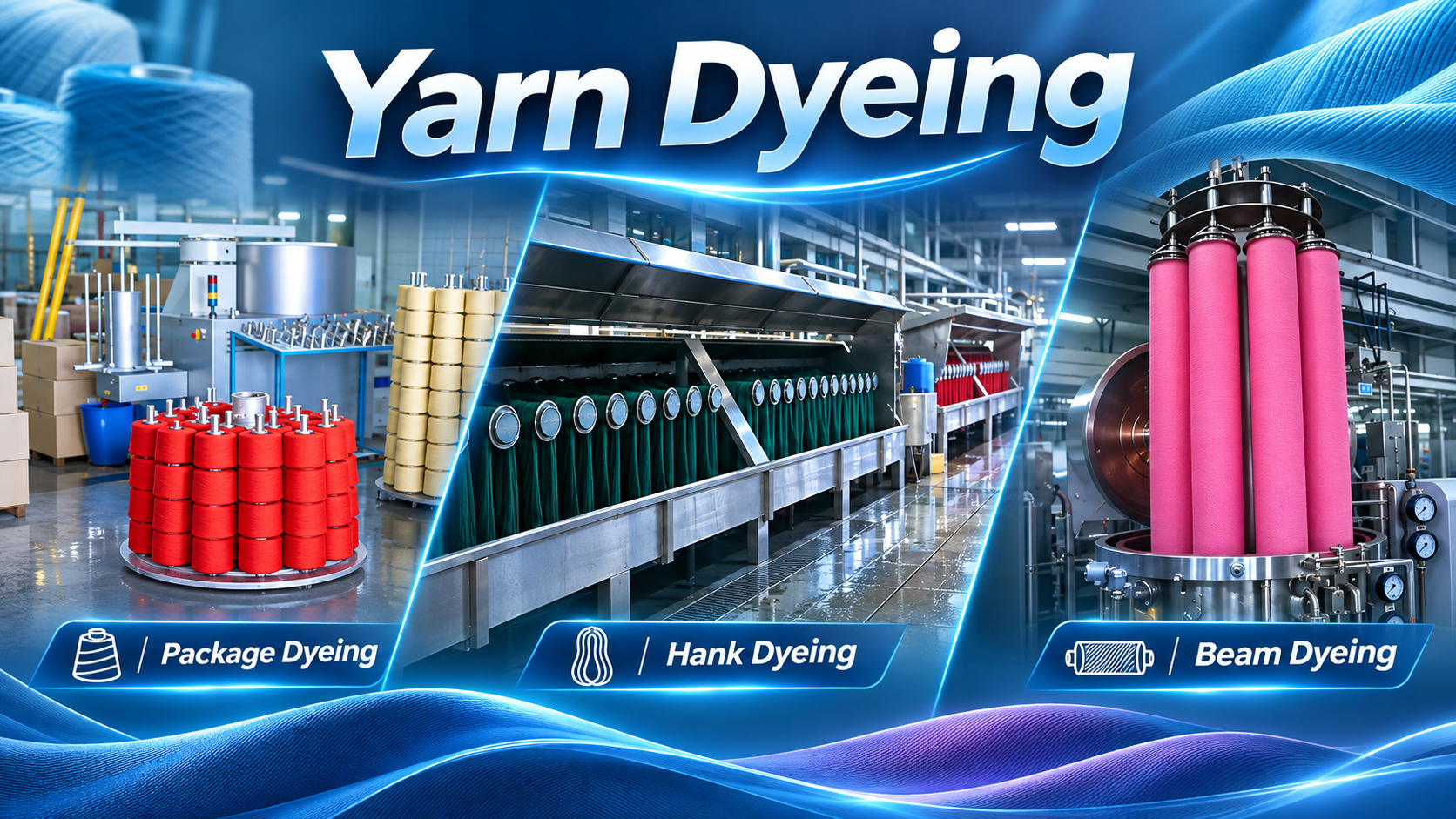
Three widely used yarn-dyeing techniques include:
- Hank dyeing: Loosely arranged yarn hanks are immersed in dye liquor. This gentle method supports a soft hand feel and is often used for premium sweater yarns.
- Package dyeing: Yarn is wound onto perforated packages while dye liquor circulates through them. It is a common, scalable industrial solution.
- Beam dyeing: Large quantities of yarn are wound onto a perforated beam for dyeing. It is well suited to high-volume, consistent-shade production.
Yarn Dyeing Process Video
Watch the video for a closer look at the process.
Source: Original video on YouTube
Third-party video shared for educational reference. Not produced by HITEK TEXTILE.
Piece Dyeing: Fabric After Weaving
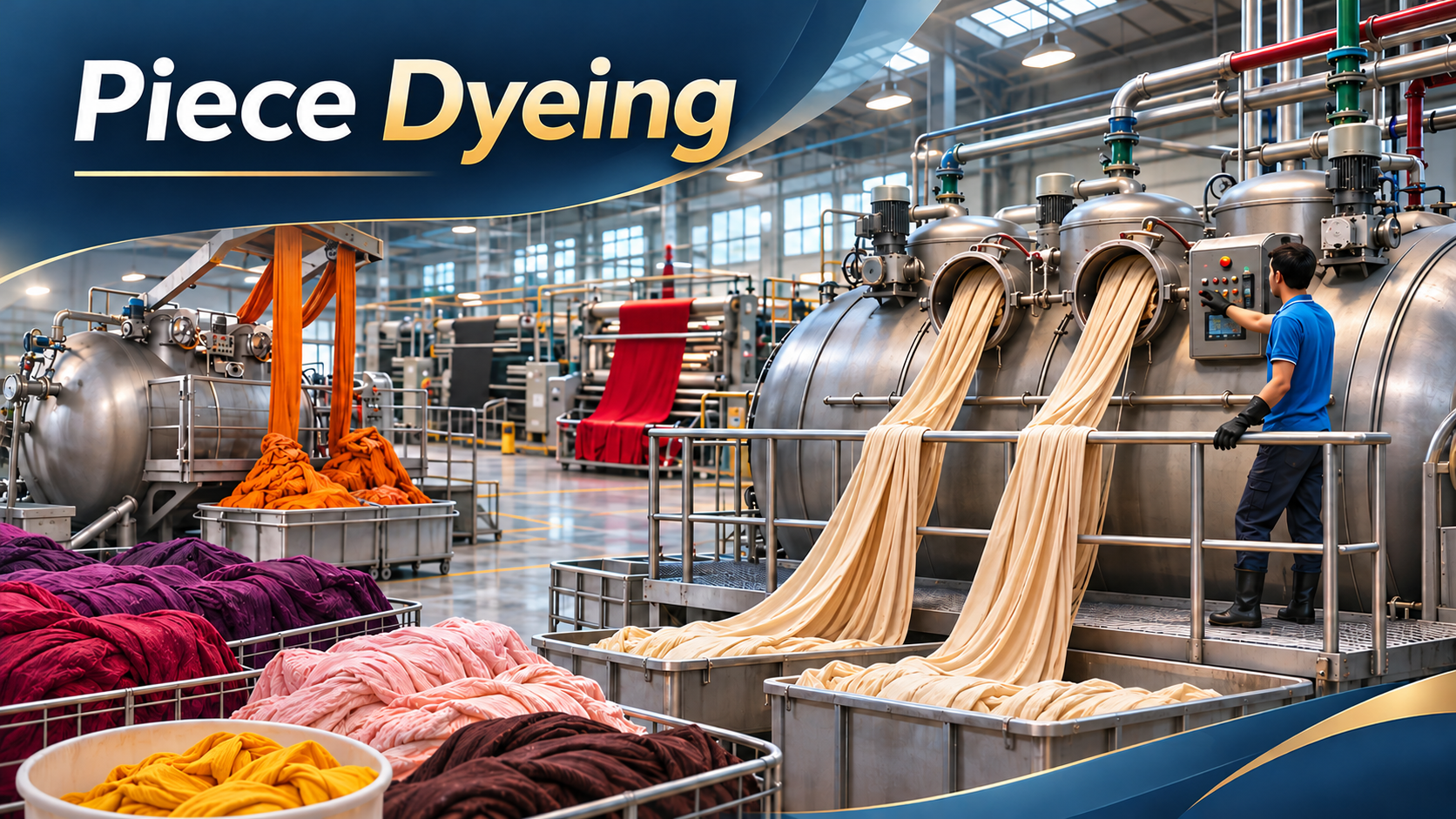
Piece dyeing colors greige fabric after weaving or knitting. Widely used for solid-color production, it allows manufacturers to dye fabric in the desired shade after fabric formation.
The process combines preparation, coloration and finishing to deliver a market-ready textile.
Typical Piece-Dyeing Workflow:
- Singeing and desizing: Remove surface fuzz and residual sizing agents from the fabric.
- Scouring and bleaching: Clear impurities and oils, preparing a clean, even base for dyeing.
- Dyeing: Treat the fabric in a dye bath to achieve consistent color and fixation.
- Washing and drying: Remove unfixed dye, then dewater and dry the fabric.
- Finishing and setting: Adjust fabric hand, width and performance with mechanical or chemical treatments.