Does Infrared Clothing Actually Work? What the Science Says

Search “infrared clothing” and you’ll find everything from serious sportswear brands to questionable Amazon listings promising miracle cures. So which is it — clever marketing, or real physics?

The short answer: far infrared (FIR) textiles are backed by real science, but not all FIR fabric is created equal. Here’s what actually matters.

What far infrared actually is

Far infrared isn’t some exotic technology — it’s a natural part of the light spectrum, the same warmth you feel from sunlight or a campfire, just without visible light. The human body itself constantly emits infrared energy in the 4–14 micrometer (μm) range as a byproduct of normal heat loss.

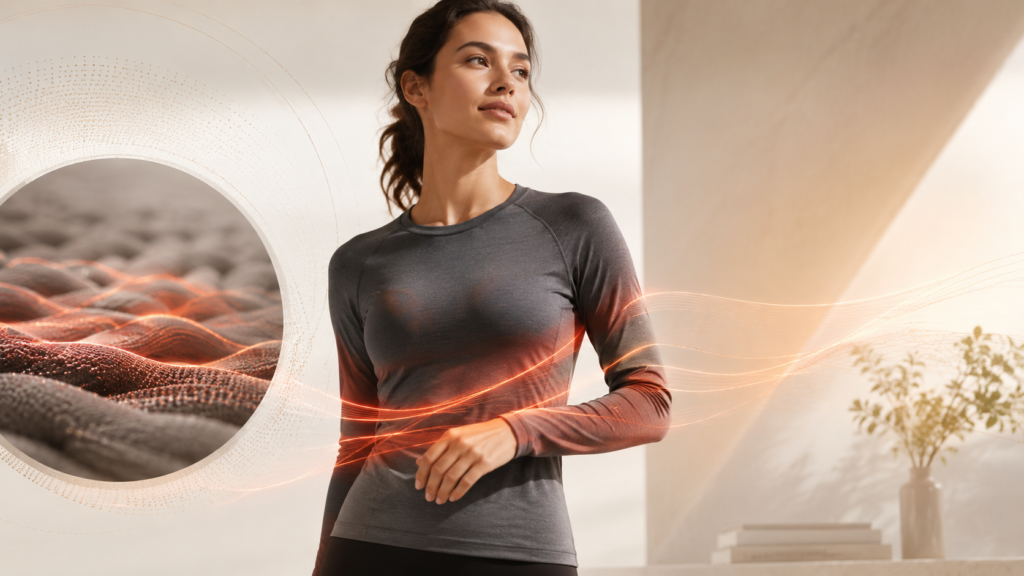
FIR textiles work by capturing some of that heat your body is already radiating away, and reflecting it back to you as far infrared energy in that same 4–14μm range — a band that is well absorbed by human tissue. This isn’t an external heat source or radiation being added to your body; it’s a passive reflection of energy you’re already producing.

Why 4–14μm specifically? Using Wien’s displacement law, the human body at normal skin temperature radiates most strongly at around 9.3–9.4μm. The 4–14μm range became the industry reference band because it brackets that natural peak — not because wider automatically means better. A material’s value comes from how well it overlaps this resonance zone, not simply from how far its range extends.

This is the natural place for the “90–95% FIR reflectivity” mechanism diagram — it visually walks through the exact process just described in text (body heat → reflected FIR → water resonance → circulation), so image and copy reinforce each other instead of repeating.

What the research says

Peer-reviewed studies on FIR textiles have reported measurable effects including improved local blood microcirculation, modest increases in skin surface temperature, and support for post-exercise muscle recovery. Independent lab testing — including thermal imaging comparisons — has documented these skin-temperature effects in controlled conditions.

It’s worth being precise here: FIR clothing is not a medical treatment and shouldn’t be marketed as one. The honest claim is that it may support circulation and comfort, not that it cures or treats any condition.

Why not all “infrared fabric” performs the same

This is the part most product descriptions skip. There are two very different ways to put FIR minerals into fabric:

  1. Surface coating — minerals are sprayed or printed onto finished fabric. Cheap to produce, but the coating typically degrades within 10–30 washes.
  2. Yarn-infused technology — minerals are embedded directly into the fiber itself during spinning, so the FIR properties are structurally permanent and don’t wash out over the garment’s lifetime.

When you’re comparing infrared clothing, the manufacturing method matters more than the marketing copy. A garment that loses its function after a month of laundering isn’t delivering what it promises.

How Hitek’s SiTEX® fits in

Hitek Textile’s SiTEX® FIR yarn uses the second approach: a U.S. and Taiwan patented dual-core spinning process that fuses over 20 natural minerals directly into the yarn structure, rather than coating the fabric surface. This is designed to deliver FIR emission across the 4–14μm reference band for the life of the garment, with FIR reflectivity independently measured at up to 95%. SiTEX also extends spectral coverage up to 16μm — broader coverage on top of the core resonance band, rather than a replacement for it.

Whether you’re developing sportswear, base layers, or sleepwear, the underlying question is the same one we opened with: is the FIR function built into the fiber, or sitting on top of it? That single manufacturing choice is what separates functional textile from marketing claim.

Scroll to Top